You might see that polycarbonate does not melt at one exact temperature because it is an amorphous material. It begins to get soft at about 147°C (297°F). Its glass transition temperature is almost 150°C (302°F). The melting point of polycarbonate, also called the pc melting point, can be between 295°C and 315°C. This depends on the grade and thickness. Knowing the polycarbonate melting point helps you pick the right material for things that need to handle heat.
Key Takeaways
Polycarbonate does not melt at one temperature. It gets soft slowly, starting near 147°C. This makes it useful for many things.
Knowing the glass transition and softening temperatures is important. It helps make polycarbonate strong and long-lasting.
Using the right temperature in injection molding is very important. It keeps polycarbonate fire-resistant and strong.
Polycarbonate is better than many plastics at handling heat. This makes it good for electronics and cars that get hot.
Polycarbonate Melting Point Overview
What Is the Melting Point of Polycarbonate?
When you use polycarbonate, you see it acts differently than many other plastics. Polycarbonate is an amorphous polymer. This means it does not melt at one exact temperature like crystalline plastics do. Instead, it slowly changes as it gets hotter. The pc melting point is not just one number. You will notice the material gets softer over several temperatures.
Note: Amorphous polymers, like polycarbonate, do not have a clear melting point. They go through a glass transition temperature (Tg). This is when they change from hard and glassy to soft and rubbery.
You can check the table below to see how scientists talk about the thermal properties of polycarbonate:
Property | Temperature (°C) |
Glass Transition Temperature | 147 |
Softening Temperature Range | 220 - 230 |
Melting Point | N/A |
The melting point of polycarbonate is often shown as "N/A" because it does not melt all at once. Instead, it gets soft and easier to work with at higher temperatures. This special way of melting makes the pc melting point important for many uses. You need to know this when picking polycarbonate for things that get hot.
Glass Transition and Softening Temperatures
The glass transition temperature (Tg) is very important for polycarbonate. When you heat it to about 147°C, it starts to bend and flex. This temperature tells you when the material will stop being stiff. The softening temperature range, usually between 220°C and 230°C, is where you can shape or mold polycarbonate with methods like injection molding or extrusion.
Polycarbonate's glass transition temperature of 147°C lets you shape it with thermoforming.
The softening temperature range of 220°C to 230°C helps you control the process during manufacturing, so you can make strong and exact parts.
The slow softening of polycarbonate helps your products stay tough and last long, even when they get hot.
You can see that the pc melting point is not just one number. Instead, you use a range of temperatures. This slow change helps stop sudden problems in your products. It also means you can use polycarbonate in places where you need both strength and heat resistance.
When you look at polycarbonate and compare it to crystalline plastics, you see a big difference. Crystalline plastics melt at one set temperature. Polycarbonate, because it is amorphous, gets soft over a range. This gives you more choices in design and how you make things.
You can also use industry standards to test these properties. Some common tests are:
Standard/Technique | Description |
ASTM D648 | Tests how well the material handles heat when loaded. |
ASTM D1525 | Measures the Vicat softening temperature to help pick polymers. |
Differential Scanning Calorimetry (DSC) | Finds phase changes and heat flow. |
Thermogravimetric Analysis (TGA) | Checks thermal stability by measuring weight loss. |
Dynamic Mechanical Analysis (DMA) | Looks at how plastics act at different temperatures. |
Knowing about the polycarbonate melting point, and its glass transition and softening temperatures, helps you make good choices. You can pick the best ways to process it and make sure your products work well in hot places. The pc melting point is very important for many modern designs.
Why Polycarbonate Melting Point Matters
Impact on Manufacturing and Processing
It is important to know the polycarbonate melting point when making things. The melting point tells you how to shape and form the material. If you use injection molding, you must watch the temperature closely. If it gets too hot, the part can turn weak or change color. If it is not hot enough, the part can break or crack later.
Here is a table that shows the usual temperatures for different polycarbonate types during molding:
Polycarbonate Type | Melt Temperature (°C) | Mold Temperature (°C) |
Standard | 280 - 320 | 80 - 100 |
High-Heat | 310 - 340 | 100 - 150 |
PC-ABS Blend | 240 - 280 | 70 - 100 |
You need to keep the melt temperature in the right range. This helps stop problems and keeps your products strong. Workers must learn how to set these temperatures. If you heat the material too much, it can lose its fire resistance and safety.
Polycarbonate injection molding is faster than other ways. You can make more parts in less time. This saves money and makes work quicker. Using the right temperature also keeps your products safe from fire.
Tip: Always check the temperature when you work with polycarbonate. This helps your parts stay safe and strong.
Product Performance and Reliability
The pc melting point is important for how well your products work. If you use the right temperature, your parts will stay strong for a long time. Studies show that parts made at higher temperatures last longer and do not crack. If you use lower temperatures, the parts might crack or break after a while.
Fire resistance is another big benefit. Polycarbonate can resist fire, but only if you use the right process. The correct pc melting point helps keep this feature in your product. This is very important for safety in things like electronics and car parts.
The polycarbonate melting point helps your products stay safe and work well. When you use polycarbonate in hot places, it keeps its shape and resists fire.
Polycarbonate vs Other Plastics
PC Melting Point vs ABS and Acrylic
When you pick materials, you must know how they handle heat. The pc melting point is higher than ABS and acrylic. This means polycarbonate stays strong in hotter places. You can see the difference in the table below:
Material | Heat Resistance |
ABS | Medium (~105°C) |
Polycarbonate | High (~147°C) |
Polycarbonate keeps its shape and strength when it gets hot. The pc melting point lets you use it where fire resistance and safety are important. For example, you can use polycarbonate for outdoor signs or safety shields. It also works well as a glass replacement. It lasts a long time in tough places.
Here are some benefits of polycarbonate:
It resists heat, impact, and bad weather.
It works well outside and as a glass alternative.
It gives high clarity and fire resistance.
It lasts long and helps keep things safe.
Polycarbonate also has these features:
Light transmittance up to 89%, almost like glass.
Impact resistance 250-300 times more than glass.
UV protection for outdoor use.
Light weight, about half as much as glass.
Flame retardant and does not make toxic gases.
Keeps its properties from -40°C to 125°C.
You can shape polycarbonate with injection molding. This makes it a good choice for products needing fire resistance and safety.
Polycarbonate vs Polyethylene
You might wonder how polycarbonate compares to polyethylene. The pc melting point for polycarbonate is much higher than LDPE and HDPE. This means polycarbonate works in places with more heat. The table below shows the melting points:
Material | Melting Point (°C) |
Polycarbonate | 288–316 |
LDPE | 102–113 |
HDPE | 120–130 |
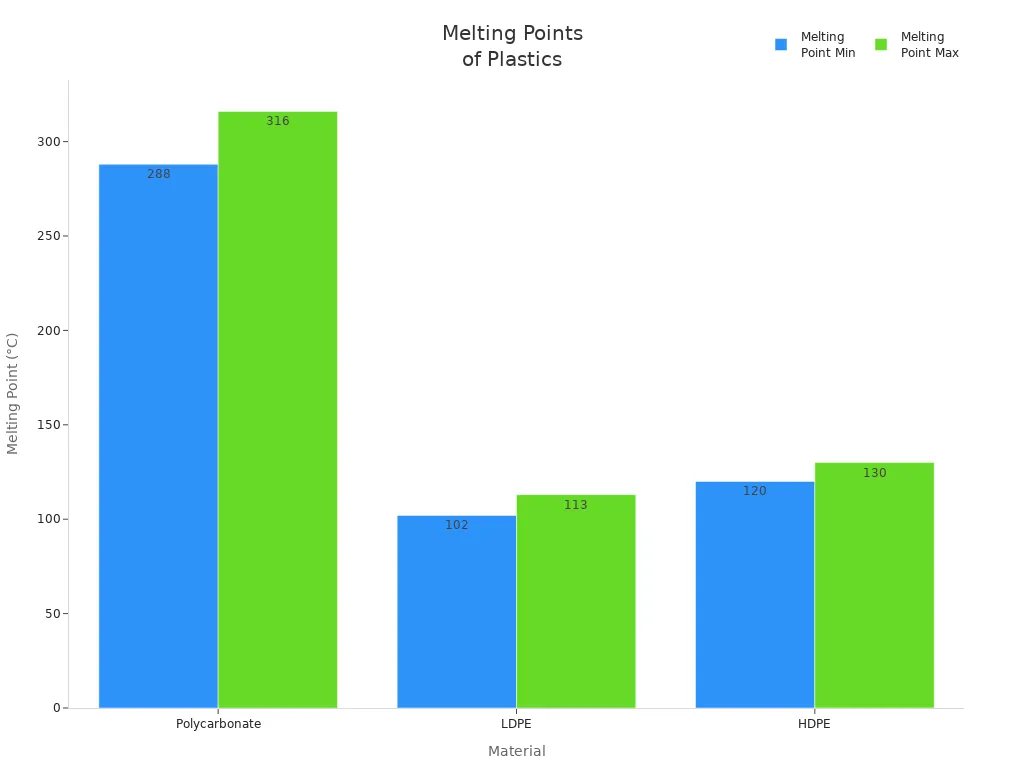
Polycarbonate has better fire resistance than polyethylene. You can trust it in places where safety matters, like electronics or car parts. The higher pc melting point means polycarbonate works where other plastics would melt.
Thermal conductivity is also important for your design. The table below shows how polycarbonate compares to other plastics:
Plastic | Thermal Conductivity (W/m·K) |
Polycarbonate (PC) | 0.19-0.22 |
Polypropylene (PP) | 0.11 |
Polystyrene (PS) | 0.14 |
Polyamide (Nylon) | 0.24 – 0.3 |
Polycarbonate has higher thermal conductivity than many plastics. This helps heat move in your products and supports safety and fire resistance.
When you pick materials, think about the pc melting point, fire resistance, and how the plastic will work in your project. Polycarbonate gives you safety, durability, and heat resistance for many uses.
Applications and Processing Challenges
High-Temperature Uses in Electronics and Automotive
Polycarbonate is used in many hot places. Electronics use it for cases and connectors. The high fire rating helps stop heat and flames. Cars use polycarbonate in headlamp lenses and inside panels. These parts need to be safe from fire. Medical devices also use polycarbonate. It keeps its shape and strength when hot. This tough material is picked for things that must last a long time.
Processing Issues: Temperature and Moisture
You must watch the temperature when molding or injecting polycarbonate. It needs the right heat for injection molding. Too much heat can take away fire resistance. Not enough heat can make weak parts. Water can also change polycarbonate during making. If it takes in water, its properties change. You might see:
You should dry polycarbonate before molding or injecting. This helps keep fire resistance and safety in your parts. Controlling heat and water makes sure your products are high quality.
You should know the melting point of polycarbonate. This helps you pick the right material for your project. Polycarbonate can get soft and weak when it gets hot.
Advanced thermal products help move heat away and keep parts steady.
There is more need for strong, energy-saving, and earth-friendly materials.
Working with others brings new ideas for electronics, cars, and building things.
Pick the best material and use smart ways to handle heat for good results.
FAQ
What makes polycarbonate a good choice for an enclosure?
Polycarbonate is strong and resists heat well. It protects your devices from damage. This material stays clear and does not break easily. You can use it for many things, like electronics and outdoor items.
Can you use polycarbonate in 3d printing for an enclosure?
You can use polycarbonate in 3d printing. It makes enclosures that are tough and resist heat. You need to set the right temperature. Polycarbonate lets you make custom parts for electronics and other projects.
How does moisture affect a polycarbonate enclosure?
Moisture can change how polycarbonate works. If it takes in water, it might get weaker. Drying the material before making helps it last longer. This keeps your enclosure strong.
Why do people pick polycarbonate over other plastics for an enclosure?
Polycarbonate handles heat better than many plastics. It also resists impacts and stays clear. Your enclosure will protect devices and look nice. Polycarbonate works for indoor and outdoor uses.
Is polycarbonate safe for electronics enclosure and 3d printing projects?
Polycarbonate is safe for electronics enclosures. It does not burn easily and keeps parts safe. For 3d printing, it makes strong enclosures. You get safety and durability for your projects.

 简体中文
简体中文 العربية
 Español
 Português
 Русский
 English
 Français
 Deutsch
 italiano
 日本語
日本語 한국어
한국어 Nederlands
 Tiếng Việt
 ไทย
ไทย Polski
 Türkçe
 አማርኛ
አማርኛ ພາສາລາວ
 ភាសាខ្មែរ
 Bahasa Melayu
 ဗမာစာ
ဗမာစာ தமிழ்
தமிழ் Filipino
 Bahasa Indonesia
 magyar
 Română
 Čeština
 Монгол
 қазақ
қазақ Српски
 हिन्दी
 فارسی
فارسی Kiswahili
 Slovenčina
 Slovenščina
 Norsk
Norsk Svenska
 українська
 Ελληνικά
 Suomi
Suomi Հայերեն
 עברית
עברית Latine
 Dansk
Dansk اردو
اردو Shqip
Shqip বাংলা
বাংলা Hrvatski
 Afrikaans
 Gaeilge
 Eesti keel
 Māori
Māori नेपाली
 Oʻzbekcha
 Беларуская мова
 Български


