


Use visual inspection for screening
Look for scratches, bubbles, color mismatch, masking damage, edge chips, contamination, warpage, and finish inconsistency before spending time on formal measurements.

Author: Site Editor Publish Time: 2026-11-20 Origin: Site

Acrylic sheet sample testing should begin with the end use because PMMA is valued for transparency in windows, lenses, optical devices, and display-like applications, while some applications require extra caution around mechanical strength and impact resistance.
Use standards to define what should be evaluated, but do not treat a standard title as proof that any supplier’s sample or future shipment already complies.
ASTM D4802-16(2024) is an active ASTM specification for poly(methyl methacrylate) acrylic plastic sheet; its scope covers monolithic methacrylate sheets and identifies property categories that may be relevant when screening sheet samples.
ASTM D1003-21 is an active test method for haze and luminous transmittance of transparent plastics, and it states that haze and luminous-transmittance data are useful for quality control and specification purposes.
When a material specification gives specimen preparation, conditioning, dimensions, or parameters, those requirements take precedence for the test setup. For purchasing, that means your RFQ should state the governing specification and acceptance limits rather than asking for a vague “clear acrylic” sample.
For transparent acrylic sheet, visual clarity is only the first screen; haze and luminous transmittance should be measured when the application depends on how light passes through or scatters within the sheet.
| Optical check | What it tells the buyer | How to use it before a bulk order |
|---|---|---|
| Luminous transmittance | Indicates the light-transmitting property of a planar transparent plastic section. | Set project-specific acceptance criteria when brightness, viewing clarity, or light output matters. |
| Haze | Indicates wide-angle light scattering that can make a transparent sheet look cloudy or milky. | Use measured haze when display faces, covers, glazing-like panels, or optical appearance must be consistent. |
| Spectral transmittance | Addresses transmission across wavelengths where the application requires more than a general clear appearance. | Request it for lighting, color-sensitive display, or optical uses only when the project specification requires it. |
The ASTM D1003 scope covers light-transmitting and wide-angle light-scattering properties of planar transparent plastic sections and provides hazemeter and spectrophotometer procedures. Buyers should use that kind of measured evidence when optical performance is a purchase condition.
Visual inspection is useful for obvious sample defects, but it is not enough when the purchase decision depends on optical, mechanical, thermal, abrasion, coating, or chemical-resistance properties.
Look for scratches, bubbles, color mismatch, masking damage, edge chips, contamination, warpage, and finish inconsistency before spending time on formal measurements.
Use measured haze and luminous transmittance when the application depends on optical performance, and document the test method and acceptance criteria before comparing samples.
Do not approve a bulk order because one hand sample looks acceptable under office lighting. A sample can pass a quick appearance check while still being unsuitable for an application that needs defined impact, abrasion, coating adhesion, chemical resistance, or thermal behavior.
Acrylic’s transparency makes it attractive for display and optical uses, but procurement should also check whether the sheet can tolerate the intended fabrication route and service exposure.
A sample only helps procurement if it is traceable to the sheet grade, color, finish, thickness, and inspection conditions that will apply to the bulk order.
If a supplier cannot connect the sample to the quoted material description, treat the result as a visual reference, not as approval evidence for the bulk shipment.
Use a pass, hold, or reject matrix so procurement decisions follow documented application criteria rather than subjective impressions.
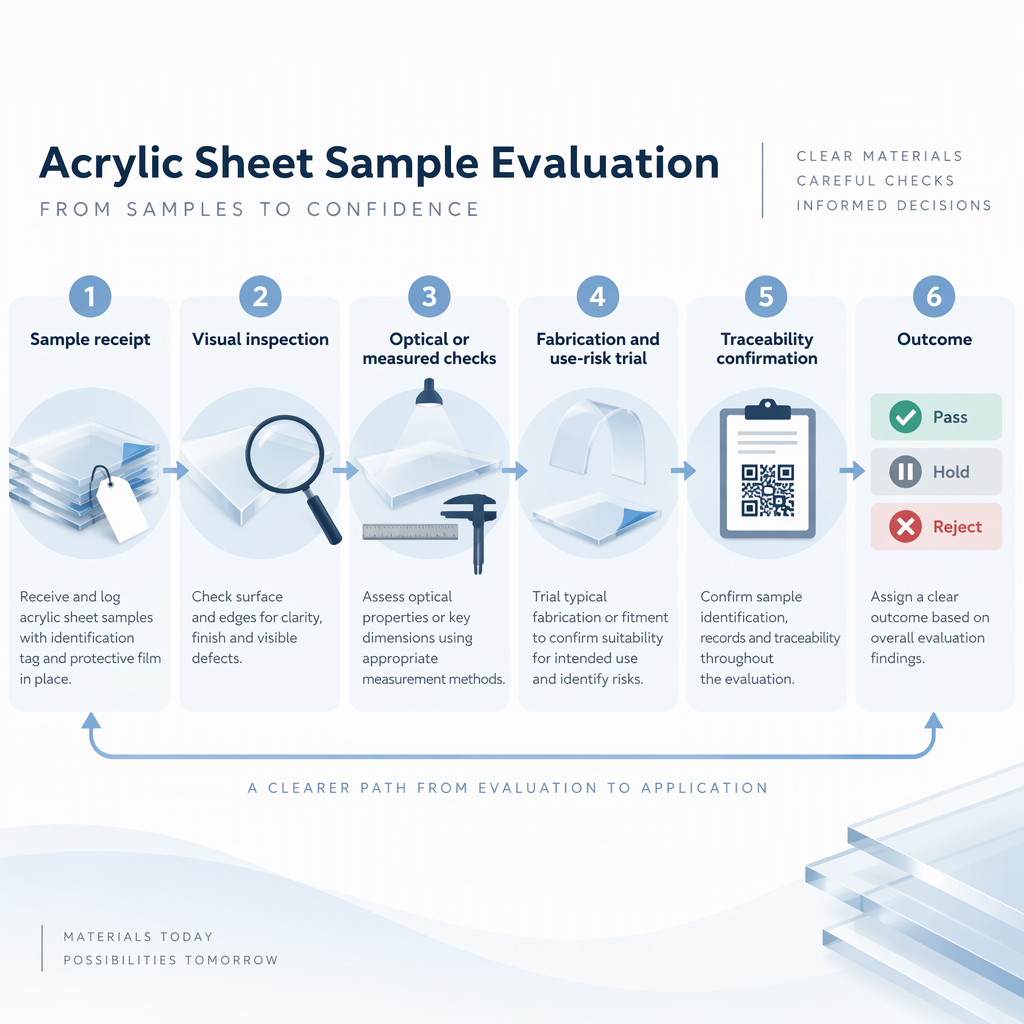
| Decision | When it fits | Buyer action |
|---|---|---|
| Pass to quotation or production trial | The sample matches the required sheet description and satisfies the application-relevant property checks. | Record the accepted criteria, test method, sample identification, and specification basis in the RFQ or trial order. |
| Hold for clarification | Appearance is acceptable, but optical data, specimen preparation, conditioning, dimensions, or parameters are missing or do not match the buyer’s specification. | Ask for corrected test conditions, a traceable report, or another sample before approving volume. |
| Reject for this application | The sample fails a required optical, mechanical, thermal, impact, abrasion, coating, or chemical-resistance requirement for the intended use. | Change the specification, request a different sheet option, or stop the sourcing route for that project. |
Before moving from sample testing to a bulk order, convert every important observation into a written supplier question or purchase requirement.
Acrylic sheet sample testing works best when procurement treats the sample as a controlled decision point: define the application, choose relevant property checks, confirm traceability, and document acceptance before volume purchasing.
Only for low-risk appearance screening. If the application depends on optical, mechanical, impact, abrasion, coating, thermal, or chemical-resistance performance, visual inspection should be followed by documented checks.
Request ASTM D1003-based haze and luminous-transmittance testing when clear appearance, display readability, glazing-like viewing, light output, or optical consistency is part of the purchase requirement.
ASTM D4802 helps identify the acrylic sheet property categories that may matter, including optical, mechanical, thermal, impact, abrasion, coating adhesion, and chemical-resistance considerations.
Set the value from your application specification, customer drawing, or agreed inspection plan. Universal limits are not reliable because thickness, color, finish, viewing distance, lighting, and end use affect what is acceptable.
Choose enough specimens to represent the quoted sheet type, thickness, color, finish, and test condition required by your specification. The important point is traceability to the future order, not a generic sample count.
Yes, when the finished part will be cut, drilled, printed, bonded, coated, formed, cleaned, or exposed to abrasion or chemicals. The trial should match the real production route and acceptance criteria.
Ask for the test method, specimen condition, sheet identification, thickness, color or finish, preparation details, measured results, and the specification or acceptance limit used for comparison.
