


PVC foam board density is a measurable plastics property that can help buyers compare uniformity, weight-related calculations, and material identity. For practical sourcing, treat density as one RFQ field to review together with board type, thickness, sheet size, quantity, surface, color, application, destination port, and required documents. For fabrication and end use, higher or lower density should start a supplier discussion about rigidity, impact resistance, surface finish, and machining behavior, not replace a project-specific technical data sheet.

What PVC foam board density means in a buying decision
PVC foam board density is useful because it gives buyers a measurable way to compare a sheet property rather than relying only on grade names or marketing descriptions.
ASTM describes density and specific gravity testing for solid plastics by displacement and notes that density can help identify materials, track physical changes, indicate uniformity, and support strength-to-weight and cost-to-weight calculations. Buyers can review the official ASTM D792 standard page when they need a recognized density measurement reference.
In a procurement conversation, density becomes most useful when it is tied to the rest of the sheet description: board type, thickness, sheet size, quantity, surface, color, application, destination port, and document requirements. A density value without those fields is too thin for a reliable quotation comparison.
How density is measured and verified
Ask for the density value, the tolerance or range, and the test method used; do not infer density only from terms such as light, medium, hard, or premium.
ASTM D792-20 is listed by ASTM as an active standard for density and specific gravity of plastics by displacement. That scope supports density as a measured plastics property, but it does not set a universal PVC foam board grade for every sign, display, cabinet, or machining job.
Use density data as a comparison input, then confirm whether the supplier's test method, sample condition, sheet thickness, and tolerance basis match your purchasing specification. If two quotations list different density ranges, compare them only after the measurement basis is clear.
What density changes for cutting, routing, drilling, and finishing
Higher-density PVC foam board is commonly discussed as more rigid and impact-resistant, while density can also influence machining and surface-finish expectations.
| Fabrication question | What density changes | Buyer action |
|---|---|---|
| Cutting and routing | Density may change the way the sheet responds to machining and fabrication. | Request recommended tooling, feed guidance, and trial-cut approval for your thickness and finish. |
| Drilling and fastening | Higher-density boards are broadly associated with greater rigidity and strength. | Ask for application-specific fastening guidance rather than assuming screw-holding strength from density alone. |
| Display finishing | Density can be part of the discussion about surface finish differences. | Check printing, painting, lamination, or film compatibility on the actual surface and color you plan to buy. |
| Thermal movement and bonding | Expanded PVC fabrication discussions often include thermal movement, adhesive bonding, stiffness, and paint-adhesion questions. | Confirm adhesive, coating, and installation limits with the supplier and with your own prototype. |
Do not use a density article as a substitute for CNC feed rates, spindle speeds, adhesive selection, or load ratings. Those values should come from the supplier's current technical data sheet and from a sample trial under your fabrication conditions.
Choosing density by application and use case
Choose the density conversation by the job: temporary display work, general signage, cabinet or furniture panels, and higher-stability uses do not need the same balance of weight, rigidity, finish, and processing.
| Use case | Density discussion to start | What to confirm before buying |
|---|---|---|
| Advertising boards and display sheets | Lower or medium density may be discussed where light weight and easy handling matter. | Confirm flatness, print surface, color, thickness, and indoor or outdoor exposure assumptions. |
| PVC cabinet board applications | Medium or higher density may be discussed where rigidity and finish are more important. | Confirm fastening method, edge finishing, load expectations, and panel support spacing. |
| Celuka, co-extrusion, and free-foam board choices | Board type should be specified along with density, because the product category is part of the buying description. | Compare board type, density range, thickness, sheet size, surface, color, and application together. |
| Higher-stability or more demanding fabrication | Higher density is broadly associated with greater rigidity, structural strength, and impact resistance. | Ask for the relevant technical data sheet and approve a prototype instead of relying on density alone. |
Boundaries: what density does not prove by itself
Density can support weight-related and cost-related comparisons, but it does not, by itself, prove the finished sheet's strength, surface quality, fire behavior, certification status, or service life.
A supplier may describe broad relationships between density, rigidity, impact resistance, surface finish, and machining, but project approval still depends on the exact board construction, thickness, tolerance, surface, and application conditions.
- For strength or screw performance, request product-specific test data rather than estimating from density.
- For printing, painting, or lamination, test the actual surface and color before volume production.
- For adhesive bonding or thermal movement concerns, ask for material-specific guidance and validate the assembly in the intended environment.
- For purchasing, keep density beside board type, thickness, sheet size, quantity, surface, color, application, destination port, and required documents.
Density selection checklist for RFQs
A clear RFQ should state the density requirement together with the sheet and application fields needed to make quotations comparable.
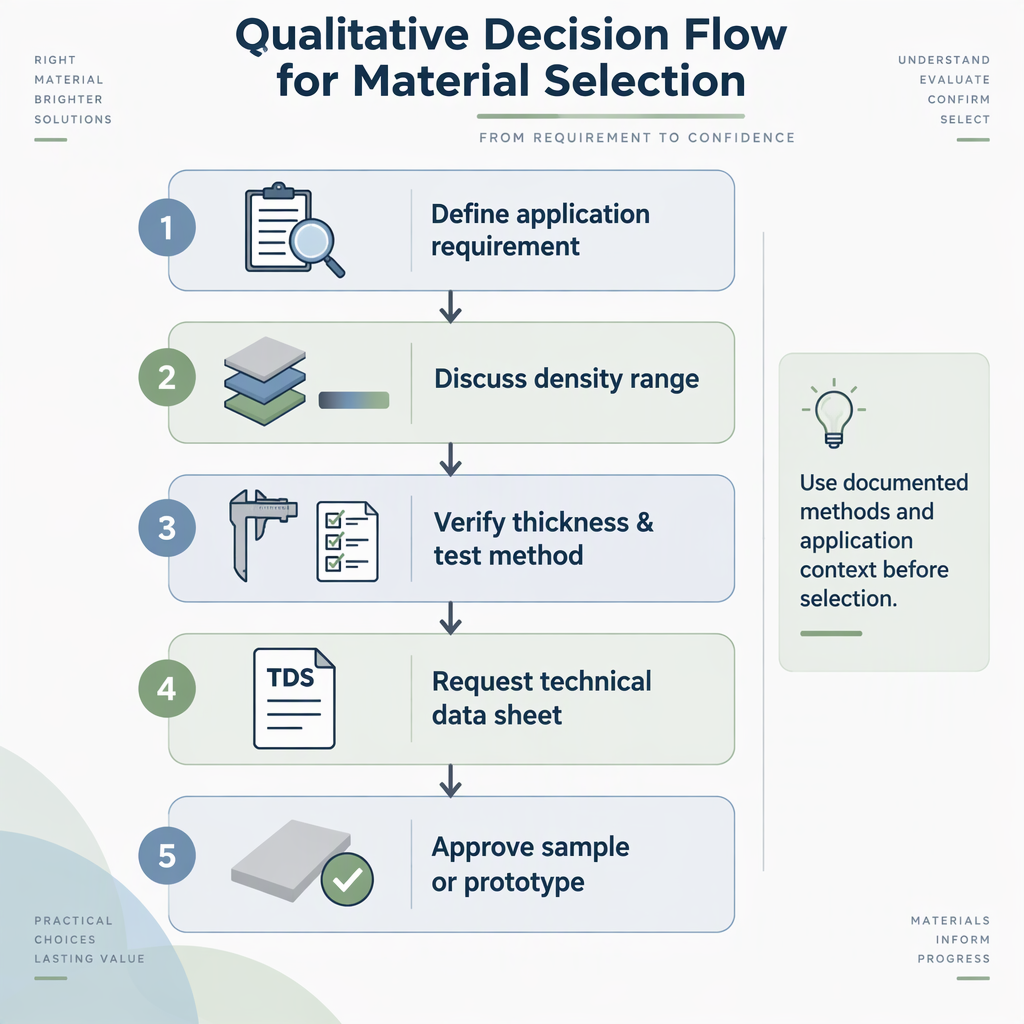
- Specify board type, such as Celuka, co-extrusion, free-foam, advertising board, or cabinet board when those categories apply.
- State the required density or acceptable density range, and ask how it is measured.
- List thickness, sheet size, quantity, surface, and color.
- Describe the application so the supplier can review whether the density discussion fits the intended use.
- Provide destination port and document requirements when they are part of the quotation package.
- Ask for the current technical data sheet, tolerance statement, and sample approval path before confirming production.
How to compare quotations when density ranges differ
When density ranges differ, compare quotations by matching the full specification first and then checking whether the density basis and application fit are equivalent.
| Comparison step | Why it matters | Decision rule |
|---|---|---|
| Confirm density measurement basis | Density is meaningful when it is measured and used consistently. | Do not treat two density values as equal unless the test method and tolerance basis are clear. |
| Match board type and dimensions | Board type, thickness, sheet size, and surface are part of the buying specification. | Compare like with like before judging a price or availability discussion. |
| Match application and documents | Application, destination port, and required certificates or documents affect the RFQ description. | Ask each supplier to quote against the same application notes and document list. |
- Shortlist quotations that state density, thickness, board type, and tolerance clearly.
- Separate density-driven questions from unsupported claims about performance, certification, or delivery.
- Approve the final choice with samples, a technical data sheet, and your own fabrication test.
Conclusion
PVC foam board density is valuable as a measured comparison property, but the best buying decision matches density with board type, thickness, sheet size, surface, color, application, and quotation requirements.
- Use density to frame expectations about rigidity, impact resistance, machining, and finish, then confirm with the supplier's technical data.
- Use a recognized density measurement basis when values must be compared across quotations.
- For advertising, display, distribution, or procurement work, approve a sample before committing to a large order.
FAQs about PVC foam board density
These questions help fabricators, distributors, and purchasing teams turn density information into a practical specification.
Is higher-density PVC foam board always better?
No. Higher density may be associated with greater rigidity and impact resistance, but the right choice depends on weight, machining, finish, thickness, cost basis, and application requirements.
Can density predict the exact CNC settings?
No. Use density as one material input, then request supplier guidance and run sample cuts for your tool, sheet thickness, surface, and machine setup.
What should a distributor ask for when comparing density ranges?
Ask for board type, density, thickness, sheet size, quantity, surface, color, application, destination port, and required documents in the same RFQ format.
Does ASTM D792 choose the right PVC foam board grade?
No. ASTM D792 supports density and specific gravity measurement for plastics by displacement; it does not decide which PVC foam board density is best for a sign, display, or cabinet project.
Should density be listed on a purchase order?
Yes, when density matters to the job. List it with board type, thickness, sheet size, surface, color, quantity, application, and document requirements so the supplier can quote the intended product.
Can density alone prove surface quality?
No. Density can be part of a surface-finish discussion, but buyers should test the actual surface for printing, painting, lamination, or film application.
What is a practical way to approve a new density for fabrication?
Request the current technical data sheet, confirm the measurement basis, buy or receive samples, and run the same cutting, fastening, finishing, and assembly checks used in production.
